Gigabit Ethernet, a transmission technology based on the Ethernet frame format and protocol used in local area networks (LANs), provides a data rate of 1 billion bits per second (one gigabit). Gigabit Ethernet is defined in the IEEE 802.3 standard and is currently being used as the backbone in many enterprise networks.
Gigabit Ethernet is carried primarily on optical fiber (with very short distances possible on copper media). Existing Ethernet LANs with 10 and 100 Mbps cards can feed into a Gigabit Ethernet backbone. An alternative technology that competes with Gigabit Ethernet is ATM. A newer standard, 10-Gigabit Ethernet, is also becoming available.
There are five physical layer standards for gigabit Ethernet using optical fiber (1000BASE-X), twisted pair cable (1000BASE-T), or balanced copper coaxial cable (1000BASE-CX).
The IEEE 802.3z standard includes 1000BASE-SX for transmission over multi-mode fiber, 1000BASE-LX for transmission over single-mode fiber, and the nearly obsolete 1000BASE-CX for transmission over balanced copper cabling. These standards use 8b/10b encoding, which inflates the line rate by 25%, from 1000 Mbit/s to 1250 Mbit/s, to ensure a DC balanced signal. The symbols are then sent using NRZ.
IEEE 802.3ab, which defines the widely used 1000BASE-T interface type, uses a different encoding scheme in order to keep the symbol rate as low as possible, allowing transmission over twisted pair.
IEEE 802.3ap defines Ethernet Operation over Electrical Backplanes at different speeds.
Ethernet in the First Mile later added 1000BASE-LX10 and -BX10.
1000BASE-X
1000BASE-X is used in industry to refer to gigabit Ethernet transmission over fiber, where options include 1000BASE-CX, 1000BASE-LX, and 1000BASE-SX, 1000BASE-LX10, 1000BASE-BX10 or the non-standard -ZX implementations.
1000BASE-CX
1000BASE-CX is an initial standard for gigabit Ethernet connections over twinaxial cabling with maximum distances of 25 meters using balanced shielded twisted pair and either DE-9 or 8P8C connector. The short segment length is due to very high signal transmission rate. Although it is still used for specific applications where cabling is done by IT professionals, for instance the IBM BladeCenter uses 1000BASE-CX for the Ethernet connections between the blade servers and the switch modules, 1000BASE-T has succeeded it for general copper wiring use.
1000BASE-KX
1000BASE-KX is part of the IEEE 802.3ap standard for Ethernet Operation over Electrical Backplanes. This standard defines 1-4 lanes of backplane links, one RX and one TX differential pair per lane, at link bandwidth ranging from 100Mbit to 10Gbit per second (from 100BASE-KX to 10GBASE-KX4). The 1000BASE-KX variant uses 1.25 GBd electrical signalling speed.
1000BASE-SX
1000BASE-SX is a fiber optic gigabit Ethernet standard for operation over multi-mode fiber using a 770 to 860 nanometer, near infrared (NIR) light wavelength.
The standard specifies a distance capability between 220 metres (62.5/125 µm fiber with low modal bandwidth) and 550 metres (50/125 µm fiber with high modal bandwidth). In practice, with good quality fiber, optics, and terminations, 1000BASE-SX will usually work over significantly longer distances.[citation needed]
This standard is highly popular for intra-building links in large office buildings, co-location facilities and carrier neutral internet exchanges.
Optical power specifications of SX interface: Minimum output power = −9.5 dBm. Minimum receive sensitivity = −17 dBm.
1000BASE-LX
1000BASE-LX is a fiber optic gigabit Ethernet standard specified in IEEE 802.3 Clause 38 which uses a long wavelength laser (1,270–1,355 nm), and a maximum RMS spectral width of 4 nm.
1000BASE-LX is specified to work over a distance of up to 5 km over 10 µm single-mode fiber.
1000BASE-LX can also run over all common types of multi-mode fiber with a maximum segment length of 550 m. For link distances greater than 300 m, the use of a special launch conditioning patch cord may be required. This launches the laser at a precise offset from the center of the fiber which causes it to spread across the diameter of the fiber core, reducing the effect known as differential mode delay which occurs when the laser couples onto only a small number of available modes in multi-mode fiber.
1000BASE-LX10
1000BASE-LX10 was standardized six years after the initial gigabit fiber versions as part of the Ethernet in the First Mile task group. It is very similar to 1000BASE-LX, but achieves longer distances up to 10 km over a pair of single-mode fiber due to higher quality optics. Before it was standardized 1000BASE-LX10 was essentially already in widespread use by many vendors as a proprietary extension called either 1000BASE-LX/LH or 1000BASE-LH.
1000BASE-EX
1000BASE-EX is a non-standard but industry accepted[citation needed] term to refer to gigabit Ethernet transmission. It is very similar to 1000BASE-LX10 but achieves longer distances up to 40 km over a pair of single-mode fibers due to higher quality optics than a LX10. Based on the,1310 nm wavelength and sometimes referred to as LH (Long Haul). Easily confused with a 1000BASE-LX10 or 1000BASE-ZX because some vendors use the LH term.
1000BASE-BX10
1000BASE-BX10 is capable of up to 10 km over a single strand of single-mode fiber, with a different wavelength going in each direction. The terminals on each side of the fibre are not equal, as the one transmitting downstream (from the center of the network to the outside) uses the 1,490 nm wavelength, and the one transmitting upstream uses the 1,310 nm wavelength.
1000BASE-ZX
1000BASE-ZX is a non-standard but industry accepted[citation needed] term to refer to gigabit Ethernet transmission using 1,550 nm wavelength to achieve distances of at least 70 km over single-mode fiber.
1000BASE-T
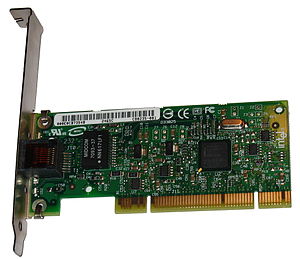
1000BASE-T capable network interface card made by Intel, which connects to the computer via PCI-X
1000BASE-T (also known as IEEE 802.3ab) is a standard for gigabit Ethernet over copper wiring.
Each 1000BASE-T network segment can be a maximum length of 100 meters (328 feet), and must use Category 5 cable or better (including Cat 5e and Cat 6).
Autonegotiation is a requirement for using 1000BASE-T according to Section 28D.5 Extensions required for Clause40 (1000BASE-T). At least the clock source has to be negotiated, as one has to be master and the other slave.
In a departure from both 10BASE-T and 100BASE-TX, 1000BASE-T uses all four cable pairs for simultaneous transmission in both directions through the use of adaptive equalization and a 5-level pulse amplitude modulation (PAM-5) technique. The symbol rate is identical to that of 100BASE-TX (125 Mbaud) and the noise immunity of the 5-level signaling is also identical to that of the 3-level signaling in 100BASE-TX, since 1000BASE-T uses 4-dimensional trellis coded modulation (TCM) to achieve a 6 dB coding gain across the 4 pairs.
Since negotiation takes place on only two pairs, if two gigabit devices are connected through a cable with only two pairs, the devices will successfully choose 'gigabit' as the highest common denominator (HCD), but the link will never come up. Most gigabit physical devices have a specific register to diagnose this behaviour. Some drivers offer an "Ethernet@Wirespeed" option where this situation leads to a slower yet functional connection.
The data is transmitted over four copper pairs, eight bits at a time. First, eight bits of data are expanded into four 3-bit symbols through a non-trivial scrambling procedure based on a linear feedback shift register; this is similar to what is done in 100BASE-T2, but uses different parameters. The 3-bit symbols are then mapped to voltage levels which vary continuously during transmission.
Automatic MDI/MDI-X Configuration is specified as an optional feature in the 1000BASE-T standard, meaning that straight-through cables will often work between gigabit-capable interfaces. This feature eliminates the need for crossover cables, making obsolete the uplink/normal ports and manual selector switches found on many older hubs and switches and greatly reduces installation errors.
1000BASE-TX
The Telecommunications Industry Association (TIA) created and promoted a standard similar to 1000BASE-T that was simpler to implement, calling it 1000BASE-TX (TIA/EIA-854). The simplified design would, in theory, have reduced the cost of the required electronics by only using one pair of wires in each direction. However, this solution required Category 6 cable and has been a commercial failure, likely due to the cabling requirement as well as the rapidly falling cost of 1000BASE-T products. Many 1000BASE-T products are advertised as 1000BASE-TX due to lack of knowledge that 1000BASE-TX is actually a different standard. The confusion between 1000BASE-T and 1000BASE-TX probably stems from the fact that most popular form of Fast Ethernet (100 Mbit/s) is known as 100BASE-TX, and the fact that many products support multiple speeds of 10/100/1000Mbit/s and are often promoted as 10/100/1000BASE-TX.
We prepared a few questions for you to answer with 3 grades peer question
go to this link for questions. Click Here
Gigabit Ethernet is carried primarily on optical fiber (with very short distances possible on copper media). Existing Ethernet LANs with 10 and 100 Mbps cards can feed into a Gigabit Ethernet backbone. An alternative technology that competes with Gigabit Ethernet is ATM. A newer standard, 10-Gigabit Ethernet, is also becoming available.
There are five physical layer standards for gigabit Ethernet using optical fiber (1000BASE-X), twisted pair cable (1000BASE-T), or balanced copper coaxial cable (1000BASE-CX).
The IEEE 802.3z standard includes 1000BASE-SX for transmission over multi-mode fiber, 1000BASE-LX for transmission over single-mode fiber, and the nearly obsolete 1000BASE-CX for transmission over balanced copper cabling. These standards use 8b/10b encoding, which inflates the line rate by 25%, from 1000 Mbit/s to 1250 Mbit/s, to ensure a DC balanced signal. The symbols are then sent using NRZ.
IEEE 802.3ab, which defines the widely used 1000BASE-T interface type, uses a different encoding scheme in order to keep the symbol rate as low as possible, allowing transmission over twisted pair.
IEEE 802.3ap defines Ethernet Operation over Electrical Backplanes at different speeds.
Ethernet in the First Mile later added 1000BASE-LX10 and -BX10.
1000BASE-X
1000BASE-X is used in industry to refer to gigabit Ethernet transmission over fiber, where options include 1000BASE-CX, 1000BASE-LX, and 1000BASE-SX, 1000BASE-LX10, 1000BASE-BX10 or the non-standard -ZX implementations.
1000BASE-CX
1000BASE-CX is an initial standard for gigabit Ethernet connections over twinaxial cabling with maximum distances of 25 meters using balanced shielded twisted pair and either DE-9 or 8P8C connector. The short segment length is due to very high signal transmission rate. Although it is still used for specific applications where cabling is done by IT professionals, for instance the IBM BladeCenter uses 1000BASE-CX for the Ethernet connections between the blade servers and the switch modules, 1000BASE-T has succeeded it for general copper wiring use.
1000BASE-KX
1000BASE-KX is part of the IEEE 802.3ap standard for Ethernet Operation over Electrical Backplanes. This standard defines 1-4 lanes of backplane links, one RX and one TX differential pair per lane, at link bandwidth ranging from 100Mbit to 10Gbit per second (from 100BASE-KX to 10GBASE-KX4). The 1000BASE-KX variant uses 1.25 GBd electrical signalling speed.
1000BASE-SX
1000BASE-SX is a fiber optic gigabit Ethernet standard for operation over multi-mode fiber using a 770 to 860 nanometer, near infrared (NIR) light wavelength.
The standard specifies a distance capability between 220 metres (62.5/125 µm fiber with low modal bandwidth) and 550 metres (50/125 µm fiber with high modal bandwidth). In practice, with good quality fiber, optics, and terminations, 1000BASE-SX will usually work over significantly longer distances.[citation needed]
This standard is highly popular for intra-building links in large office buildings, co-location facilities and carrier neutral internet exchanges.
Optical power specifications of SX interface: Minimum output power = −9.5 dBm. Minimum receive sensitivity = −17 dBm.
1000BASE-LX
1000BASE-LX is a fiber optic gigabit Ethernet standard specified in IEEE 802.3 Clause 38 which uses a long wavelength laser (1,270–1,355 nm), and a maximum RMS spectral width of 4 nm.
1000BASE-LX is specified to work over a distance of up to 5 km over 10 µm single-mode fiber.
1000BASE-LX can also run over all common types of multi-mode fiber with a maximum segment length of 550 m. For link distances greater than 300 m, the use of a special launch conditioning patch cord may be required. This launches the laser at a precise offset from the center of the fiber which causes it to spread across the diameter of the fiber core, reducing the effect known as differential mode delay which occurs when the laser couples onto only a small number of available modes in multi-mode fiber.
1000BASE-LX10
1000BASE-LX10 was standardized six years after the initial gigabit fiber versions as part of the Ethernet in the First Mile task group. It is very similar to 1000BASE-LX, but achieves longer distances up to 10 km over a pair of single-mode fiber due to higher quality optics. Before it was standardized 1000BASE-LX10 was essentially already in widespread use by many vendors as a proprietary extension called either 1000BASE-LX/LH or 1000BASE-LH.
1000BASE-EX
1000BASE-EX is a non-standard but industry accepted[citation needed] term to refer to gigabit Ethernet transmission. It is very similar to 1000BASE-LX10 but achieves longer distances up to 40 km over a pair of single-mode fibers due to higher quality optics than a LX10. Based on the,1310 nm wavelength and sometimes referred to as LH (Long Haul). Easily confused with a 1000BASE-LX10 or 1000BASE-ZX because some vendors use the LH term.
1000BASE-BX10
1000BASE-BX10 is capable of up to 10 km over a single strand of single-mode fiber, with a different wavelength going in each direction. The terminals on each side of the fibre are not equal, as the one transmitting downstream (from the center of the network to the outside) uses the 1,490 nm wavelength, and the one transmitting upstream uses the 1,310 nm wavelength.
1000BASE-ZX
1000BASE-ZX is a non-standard but industry accepted[citation needed] term to refer to gigabit Ethernet transmission using 1,550 nm wavelength to achieve distances of at least 70 km over single-mode fiber.
1000BASE-T
1000BASE-T capable network interface card made by Intel, which connects to the computer via PCI-X
1000BASE-T (also known as IEEE 802.3ab) is a standard for gigabit Ethernet over copper wiring.
Each 1000BASE-T network segment can be a maximum length of 100 meters (328 feet), and must use Category 5 cable or better (including Cat 5e and Cat 6).
Autonegotiation is a requirement for using 1000BASE-T according to Section 28D.5 Extensions required for Clause40 (1000BASE-T). At least the clock source has to be negotiated, as one has to be master and the other slave.
In a departure from both 10BASE-T and 100BASE-TX, 1000BASE-T uses all four cable pairs for simultaneous transmission in both directions through the use of adaptive equalization and a 5-level pulse amplitude modulation (PAM-5) technique. The symbol rate is identical to that of 100BASE-TX (125 Mbaud) and the noise immunity of the 5-level signaling is also identical to that of the 3-level signaling in 100BASE-TX, since 1000BASE-T uses 4-dimensional trellis coded modulation (TCM) to achieve a 6 dB coding gain across the 4 pairs.
Since negotiation takes place on only two pairs, if two gigabit devices are connected through a cable with only two pairs, the devices will successfully choose 'gigabit' as the highest common denominator (HCD), but the link will never come up. Most gigabit physical devices have a specific register to diagnose this behaviour. Some drivers offer an "Ethernet@Wirespeed" option where this situation leads to a slower yet functional connection.
The data is transmitted over four copper pairs, eight bits at a time. First, eight bits of data are expanded into four 3-bit symbols through a non-trivial scrambling procedure based on a linear feedback shift register; this is similar to what is done in 100BASE-T2, but uses different parameters. The 3-bit symbols are then mapped to voltage levels which vary continuously during transmission.
Automatic MDI/MDI-X Configuration is specified as an optional feature in the 1000BASE-T standard, meaning that straight-through cables will often work between gigabit-capable interfaces. This feature eliminates the need for crossover cables, making obsolete the uplink/normal ports and manual selector switches found on many older hubs and switches and greatly reduces installation errors.
1000BASE-TX
The Telecommunications Industry Association (TIA) created and promoted a standard similar to 1000BASE-T that was simpler to implement, calling it 1000BASE-TX (TIA/EIA-854). The simplified design would, in theory, have reduced the cost of the required electronics by only using one pair of wires in each direction. However, this solution required Category 6 cable and has been a commercial failure, likely due to the cabling requirement as well as the rapidly falling cost of 1000BASE-T products. Many 1000BASE-T products are advertised as 1000BASE-TX due to lack of knowledge that 1000BASE-TX is actually a different standard. The confusion between 1000BASE-T and 1000BASE-TX probably stems from the fact that most popular form of Fast Ethernet (100 Mbit/s) is known as 100BASE-TX, and the fact that many products support multiple speeds of 10/100/1000Mbit/s and are often promoted as 10/100/1000BASE-TX.
We prepared a few questions for you to answer with 3 grades peer question
go to this link for questions. Click Here
No comments:
Post a Comment